

Acacia mangium 


System : Terrestrial
Kingdom
Phylum
Class
Order
Family
Plantae
Magnoliophyta
Magnoliopsida
Fabales
Fabaceae
- Not Evaluated
NE - No Alien Population
NA - Data Deficient
DD - Minimal Concern
MC - Minor
MN - Moderate
MO - Major
MR - Massive
MV
- General
- Distribution
- Impact
- Management
- Bibliography
- Contact
Common name
hickory wattle (English, Australia), Sabah salwood (English, Australia), tongke hutan (English, Indonesia), biar (English, Papua New Guinea), manggee hutan (English, Indonesia), brown salwood (English, Australia), mangium (English, Australia)
Synonym
Acacia glaucescens , sensu Kaneh. & Hatus.
Acacia holosericea , A. Cunn.
Acacia holosericea , G. Don var. glabrata auct. non Maiden
Acacia holosericea , G. Don var. multispirea auct. non Domin
Acacia holosericea , G. Don var. neurocarpa auct. non (Hook.) Domin
Mangium montanum , Rumph.
Racosperma mangium , (Willd.) Pedley
Acacia holosericea , A. Cunn.
Acacia holosericea , G. Don var. glabrata auct. non Maiden
Acacia holosericea , G. Don var. multispirea auct. non Domin
Acacia holosericea , G. Don var. neurocarpa auct. non (Hook.) Domin
Mangium montanum , Rumph.
Racosperma mangium , (Willd.) Pedley
Similar species
Summary
Acacia mangium is a fast-growing tree that produces many seeds. Used for forestry and ecological restoration, it was widely planted and cultivated in many Pacific islands. It has naturalized in many cases and it is a threat to indigenous flora.
Species Description
Please follow this link description of Acacia mangium (brown salwood).
Habitat Description
Please follow this link for a habitat description of Acacia mangium (brown salwood).
Principal source:
Compiler: Comité français de l'UICN (IUCN French Committee) & IUCN SSC Invasive Species Specialist Group (ISSG)
Review:
Publication date: 2008-03-14
Recommended citation: Global Invasive Species Database (2026) Species profile: Acacia mangium. Downloaded from http://www.iucngisd.org/gisd/speciesname/Acacia+mangium on 24-10-2026.
Countries (or multi-country features) with distribution records for Acacia mangium
ALIEN RANGE
- [1] australia
- [1] bangladesh
- [1] brazil
- [1] brunei darussalam
- [1] cameroon
- [1] china
- [1] congo
- [1] costa rica
- [1] french guiana
- [1] indonesia
- [1] lao people's democratic republic
- [3] malaysia
- [1] mayotte
- [1] myanmar
- [1] nepal
- [1] philippines
- [1] thailand
- [1] united states
- [1] viet nam
NATIVE RANGE
- australia
- indonesia
- papua new guinea
Informations on Acacia mangium has been recorded for the following locations. Click on the name for additional informations.
Lorem Ipsum
| Location | Status | Invasiveness | Occurrence | Source |
Details of Acacia mangium in information
Status
Invasiveness
Arrival date
Occurrence
Source
Introduction
Species notes for this location
Location note
Management notes for this location
Method:
Source:
Start date:
End date:
Impact
 Mechanism:
 Outcome:
 Ecosystem services:
Impact information
Red List assessed species 11: VU = 3; NT = 2; LC = 6;
- Chukrasia tabularis LC
- Conilurus penicillatus VU
- Dalbergia tonkinensis VU
- Mauritia flexuosa LC
- Melomys burtoni LC
- Mesembriomys gouldii NT
- Petaurus breviceps LC
- Phascogale tapoatafa NT
- Rattus tunneyi LC
- Reinwardtipicus validus LC
- Sminthopsis butleri VU
Locations

 AUSTRALIABRAZILBRUNEI DARUSSALAMCHINACONGOINDONESIAMALAYSIAPHILIPPINESTHAILANDVIET NAM
Mechanism
[4] Competition
Competition- BRAZIL
- BRUNEI DARUSSALAM
- PHILIPPINES
- THAILAND
[1] Disease transmission
Disease transmission- INDONESIA
[1] Poisoning/Toxicity
Poisoning/Toxicity- BRUNEI DARUSSALAM
[1] Rooting/Digging
Rooting/Digging- CHINA
[1] Trampling
Trampling- CHINA
[2] Flammability
Flammability[6] Interaction with other invasive species
Interaction with other invasive species- AUSTRALIA
- BRAZIL
- CONGO
- MALAYSIA
- VIET NAM
Outcomes
[1] Environmental Ecosystem - Habitat
Environmental Ecosystem - Habitat- [1] Reduction in native biodiversity
Management information
Bibliography
31 references found for Acacia mangium
Management information
Management information
Bernhard-Reversat F and Schwartz D (1997) Change in lignin content during litter decomposition in tropical forest soils (Congo): comparison of exotic plantations and native stands. Comptes Rendus de l'Académie des Sciences-Series IIA-Earth and Planetary Science 325(6): 427-432.
Heringer, G., Thiele, J., Meira-Neto, J.A.A. and Neri, A.V., 2019. Biological invasion threatens the sandy-savanna Mussununga ecosystem in the Brazilian Atlantic Forest. Biological Invasions, 21(6), pp.2045-2057.
Hernandes Volpato, G. and Venâncio Martins, S., 2013. The bird community in naturally regenerating Myracrodruon urundeuva (Anacardiaceae) forest in Southeastern Brazil. Revista de Biología Tropical, 61(4), pp.1585-1595.
Islam SN, Mohamad SMBH, Azad AK (2019) Acacia spp.: invasive trees along the Brunei coast, Borneo. In Impacts of Invasive Species on Coastal Environments. Springer, Cham: 455-476.
Ismail NAN and Metali F (2014) Allelopathic effects of invasive Acacia mangium on germination and growth of local paddy varieties. Journal of Agronomy 13(4): 158-168.
Osunkoya OO, Othman FE, Kahar RS (2005) Growth and competition between seedlings of an invasive plantation tree, Acacia mangium, and those of a native Borneo heath-forest species. Melastoma Beccarianum. Ecological Research 20: 205-214.
Thu PQ, Quang DN, Chi NM, Hung TX, Binh LV, Dell B (2021) New and emerging insect pest and disease threats to forest plantations in Vietnam. Forests 12(10): 1301.
General information
Barthelat, F. 2005. Note sur les esp�ces exotiques envahissantes � Mayotte. Direction de l�Agriculture et de la For�t. 30p
Summary: Tableau synth�tique des plantes exotiques de Mayotte class�es en fonction de leur niveau d envahissement.
Summary: Tableau synth�tique des plantes exotiques de Mayotte class�es en fonction de leur niveau d envahissement.
Chey VK, Holloway JD, Speight MR, (1997) Diversity of moths in forest plantations and natural forests in Sabah. Bulletin of Entomological Research 87(4): 371-385.
Duan W, Ren H, Fu S, Wang J, Zhang J, Yang L, Huang C (2010) Community comparison and determinant analysis of understory vegetation in six plantations in South China. Restoration Ecology 18(2): 206-214.
Firth, Ronald S. C., John C. Z. Woinarski, Kym G. Brennan, Craig Hempel, 2006. Environmental relationships of the brush-tailed rabbit-rat, Conilurus penicillatus, and other small mammals on the Tiwi Islands, northern Australia. Journal of Biogeography Volume 33, Issue 10, pages 1820-1837, October 2006
International Legume Database & Information Service (IDLIS)., 2008. Acacia mangium
Summary: Available from: http://www.ildis.org/LegumeWeb?version~10.01&LegumeWeb&tno~23511&genus~Acacia&species~mangium [Accessed 20 March 2008]
Summary: Available from: http://www.ildis.org/LegumeWeb?version~10.01&LegumeWeb&tno~23511&genus~Acacia&species~mangium [Accessed 20 March 2008]
Kamo K, Vacharangkura T, Tiyanon S, Viriyabuncha C, Nimpila S, Doangsrisen B (2002) Plant species diversity in tropical planted forests and implication for restoration of forest ecosystems in Sakaerat, Northeastern Thailand. Japan Agricultural Research Quarterly: JARQ 36(2): 111-118.
Khorsand Rosa R and Koptur S (2013) New findings on the pollination biology of Mauritia flexuosa (Arecaceae) in Roraima, Brazil: linking dioecy, wind, and habitat. American journal of botany 100(3): 613-621.
Kreutz K, Fischer F, Linsenmair KE (2012) Timber plantations as favourite habitat for giant anteaters. Mammalia 76: 137-142.
Londe V, de Sousa HC, Messias MCTB (2020) Monitoring of forest components reveals that exotic tree species are not always invasive in areas under ecological restoration. Environmental Monitoring and Assessment 192(10): 1-10.
Marsaro Júnior AL, Peronti ALBG, Costa VA, Morais EGF, Pereira PDS (2016) First report of Lecanodiaspis dendrobii Douglas, 1892 (Hemiptera: Lecanodiaspididae) and the associated parasitoid Cephaleta sp.(Hymenoptera: Pteromalidae) in Brazil. Brazilian Journal of Biology 76: 250-255.
Meira-Neto JAA, da Silva MCNA, Tolentino GS, Gastauer M, Buttschardt T, Ulm F, Máguas C (2018). Early Acacia invasion in a sandy ecosystem enables shading mediated by soil, leaf nitrogen and facilitation. Biological Invasions 20(6): 1567-1575.
Pascal, O. 1997. La V�g�tation naturelle � Mayotte, Etudes quantitatives et qualitatives. DAF, SEF Mayotte. 90 pp.
Pascal, O. 2002. Plantes et for�ts de Mayotte. Patrimoines naturels, 53 : 1-108.
Royal Botanic Gardens, Kew, 2011. Acacia mangium (brown salwood)
Summary: Available from: http://www.padil.gov.au/pests-and-diseases/Pest/Main/136599 [Accessed 7 August 2011]
Summary: Available from: http://www.padil.gov.au/pests-and-diseases/Pest/Main/136599 [Accessed 7 August 2011]
Sheldon FH, Styring A, Hosner PA (2010) Bird species richness in a Bornean exotic tree plantation: A long-term perspective. Biological conservation 143(2): 399-407.
Souza AO, Chaves MDPSR, Barbosa RI, Clement CR (2018) Local ecological knowledge concerning the invasion of Amerindian lands in the northern Brazilian Amazon by Acacia mangium (Willd.). Journal of ethnobiology and ethnomedicine 14(1): 1-14.
Styring AR, Ragai R, Unggang J, Stuebing R, Hosner PA, Sheldon FH (2011) Bird community assembly in Bornean industrial tree plantations: effects of forest age and structure. Forest Ecology and Management 261(3): 531-544.
Styring AR, Unggang J, Jukie A, Tateh O, Megom N, Sheldon FH (2018) Bird community structure in native forest fragments and Acacia mangium plantations in Borneo. The Wilson Journal of Ornithology 130(1): 112-130.
Suhaili ALR, Tennakoon KU, Sukri RS (2015) Soil seed bank of an exotic Acacia sp. Plantation and an adjacent tropical heath forest in Brunei Darussalam. BIOTROPIA-The Southeast Asian Journal of Tropical Biology 22: 140-150.
Tiffani NA and Ramdan H (2020) The Characteristics of Acacia mangium Stands at Site 23 B, RPH Maribaya, BKPH Parung Panjang, KPH Bogor which is attacked by pests and diseases. In IOP Conference Series: Earth and Environmental Science 528(1): 012043. IOP Publishing.
Tulod AM, Casas JV, Marin RA, Ejoc JAB (2017) Diversity of native woody regeneration in exotic tree plantations and natural forest in Southern Philippines. Forest science and technology 13(1): 31-40.
USDA, ARS, 2008. Acacia mangium Willd.National Genetic Resources Program.Germplasm Resources Information Network - (GRIN) [Online Database]. National Germplasm Resources Laboratory, Beltsville, Maryland.
Summary: Information on taxonomy, synonyms and distribution.
Available from: http://www.ars-grin.gov/cgi-bin/npgs/html/taxon.pl?403168 [Accessed 10 March 2008]
Summary: Information on taxonomy, synonyms and distribution.
Available from: http://www.ars-grin.gov/cgi-bin/npgs/html/taxon.pl?403168 [Accessed 10 March 2008]
Vos, P. 2004. Case Studies on the Status of Invasive Woody Plant Species in the Western Indian Ocean. 2. The Comoros Archipelago (Union of the Comoros and Mayotte). FAO.
Summary: Article de synth�se sur les esp�ces ligneuses envahissantes dans l archipel des Comores et � Mayotte et les strat�gies de gestion d�velopp�es localement.
Available from: http://www.fao.org/forestry/webview/media?mediaId=6556&langId=2 [Accessed 20 March 2008]
Summary: Article de synth�se sur les esp�ces ligneuses envahissantes dans l archipel des Comores et � Mayotte et les strat�gies de gestion d�velopp�es localement.
Available from: http://www.fao.org/forestry/webview/media?mediaId=6556&langId=2 [Accessed 20 March 2008]
Woinarski, J.C.Z., 2000. The conservation status of rodents in the monsoonal tropics of the Northern Territory. Wildlife Research, 27, 421�435.
Contact
The following 2 contacts offer information an advice on Acacia mangium
Barthelat,
Fabien
Fabien
Organization:
Assistant Technique Union Internationale pour la Conservation de la Nature Initiative Cara�bes
Email:
Address:
C/O Parc National de Guadeloupe Habitation Beausoleil, Mont�ran 97120 Saint-Claude, Guadeloupe
Phone:
(+590) (0)590 80 86 00
Fax:
(+590) (0)590 80 05 46
Tassin,
Jacques
Jacques
Geographic region: Indian Ocean, Pacific
Ecosystem: Terrestrial
Ecosystem: Terrestrial
Organization:
Centre de coop�ration internationale en recherche agronomique pour le d�veloppement
Email:
Address:
CIRAD TA 10 / D Campus International de Baillarguet 34398 Montpellier Cedex 5 France
Phone:
+33 4 67 59 38 22
Fax:
MR
Acacia mangium
hickory wattle, Sabah salwood, tongke hutan, biar, manggee hutan, brown salwood, mangium
hickory wattle, Sabah salwood, tongke hutan, biar, manggee hutan, brown salwood, mangium
Date assessed
2022-06-02
Year published
Eicat category
MR (Major)
Justification for EICAT assessment
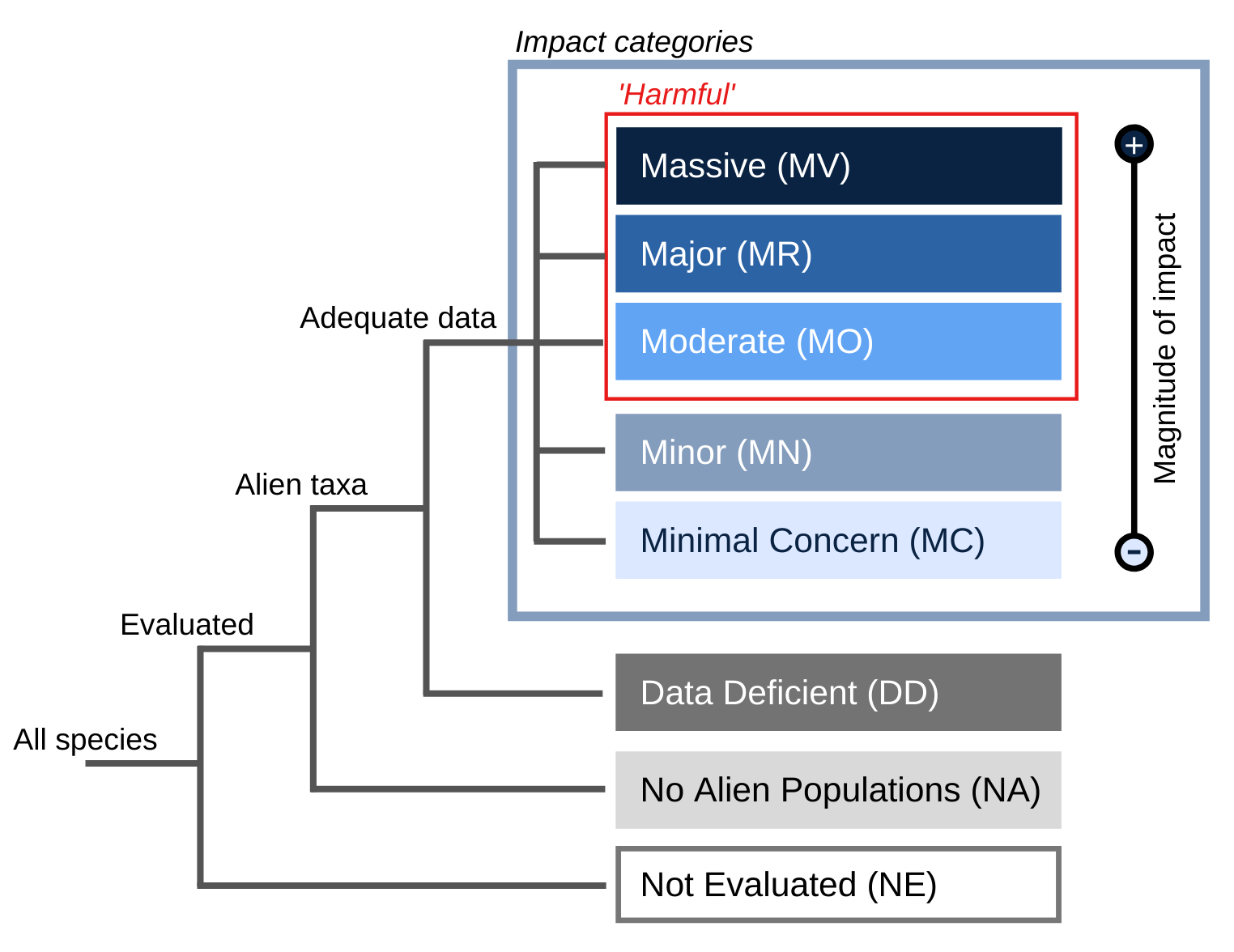
Comparisons of the soil seed banks between an A. mangium plantation and the adjacent heath forest have shown higher seed density, viability and species richness in the heath forest than in the A. mangium plantation (Suhaili et al. 2015). Less native plant species were found at invaded sites (Tulod et al. 2017; Islam et al. 2019). Some native birds were lost from sites with A. mangium compared to native forests (Sheldon et al. 2010; Styring et al. 2011; Hernandes Volpato and Venâncio Martins 2013; Souza et al. 2018), as were some mammals (Firth et al. 2006). Moth diversity was lower (Chey et al. 1997).
Confidence rating
Low
Mechanism(s) of maximum impact
Indirect impacts through interactions with other species; Competition
Countries of most severe impact
Malaysia; Australia; Brunei Darussalam; Brazil; Philippines
Description of impacts
Chemical impact on ecosystem - Acacia litter affects the abundance of white rot fungi compared to native forests.
Indirect impacts through interactions with other species - the number of native plants, birds and some mammals were lower in A. mangium sites as compared to adjacent univavded sites.
Competition - It was found that A. mangium sites have lower seed density, variability and species richness than native forests.
Poisoning/toxicity - Acacia mangium leaf extract exhibits allelopathic impacts on local rice varieties of paddy Laila and paddy Pusu.
Transmission of disease - Symptoms of pests found in A. mangium are hollow leaves caused by Pteroma plagiophleps and damage to roots caused by Lepidiota stigma.
Assessor
Sabrina Kumschick
Contributors
Reviewers
EICAT authority
Recommended citation
Sabrina Kumschick (2026). Acacia mangium. IUCN Environmental Impact Classification for Alien Taxa (EICAT).