Rubus ellipticus 

System : Terrestrial
Kingdom
Phylum
Class
Order
Family
Plantae
Magnoliophyta
Magnoliopsida
Rosales
Rosaceae
- General
- Distribution
- Impact
- Management
- Bibliography
- Contact


Common name
Himalaya-Wildhimbeere (German), golden evergreen raspberry (English), broadleafed bramble (English), yellow Himalayan raspberry (English, Hawaii), Ceylon blackberry (English), eelkek (English), kohkihl (English, Kosrae), Molucca berry (English), Molucca bramble (English), Molucca raspberry (English), wild blackberry (English), wild raspberry (English), Asian wild raspberry (English), wa votovotoa (English, Fiji), wa sori (English, Fiji), wa ngandrongandro (English, Fiji), soni (English, Fiji), piquant lou-lou (French, Mauritius), robust blackberry (English, United States of America), yellow Himalayan raspberry (English)
Synonym
Similar species
Summary
Rubus ellipticus is a thorny shrub that originates from southern Asia. It has been introduced to several places, including Hawai'i, Southern USA and the UK, and is grown in cultivation for its edible fruits. This plant has become a major pest in Hawai'i, threatening its own native species of raspberry (Rubus Hawai'iensis), and the ability of this plant to thrive in diverse habitat types makes it a particularly threatening invasive plant.
Species Description
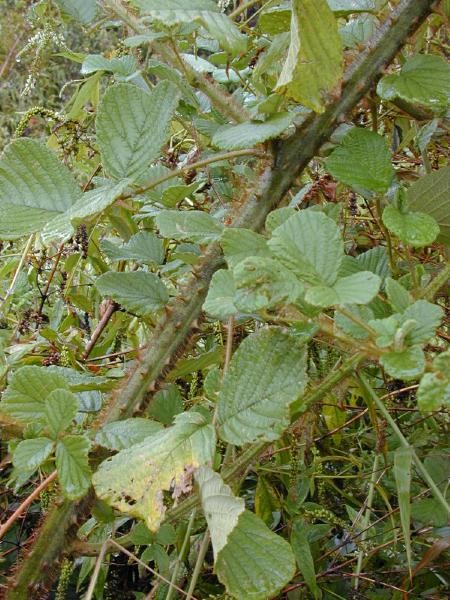
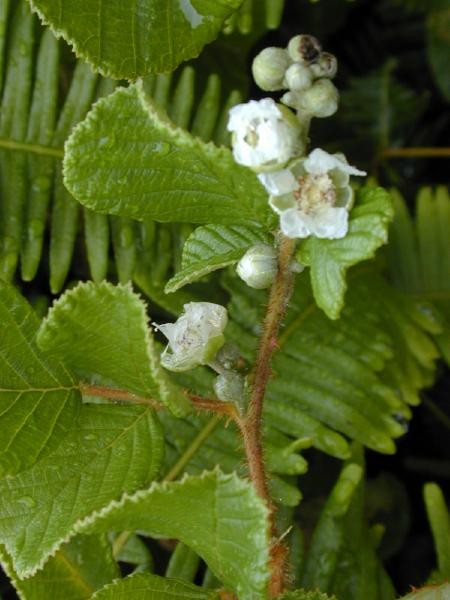
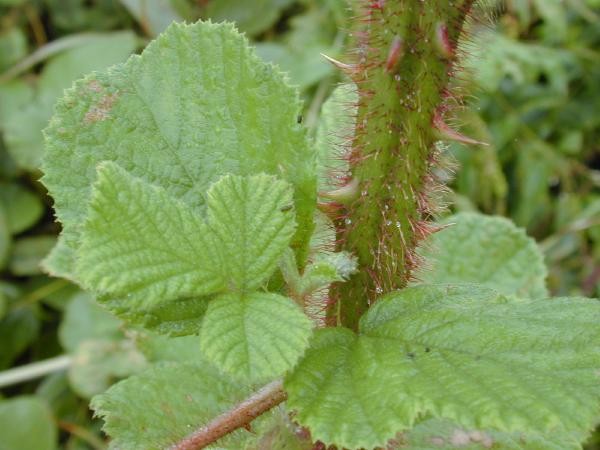
Rubus ellipticus is a stout evergreen shrub with prickly stem that grows approximately 4.5 metres tall. Its stems are covered with prickles and reddish hairs. Leaves are alternate and compound with three round to blunt leaflets of 5 to 10 centimetres long. The underside of the leaves are lighter than the upper surface and covered with downy hairs. The flowers are small and white with five petals. The fruit is a round yellow cluster of druplets which is easily detached from the receptacle (Environmental laboratory Undated)
Notes
The Himalayan raspberry can support large populations of cosmopolitan Drosophila that breed primarily on rotting fruit (Foote Undated).
Uses
The inner bark of the Rubus ellipticus plant is valued as a medicinal herb in traditional Tibetan medicine, including its use as a renal tonic and antidiuretic. Its fruits are edible and can also be used to produce a purplish blue dye (Plants For A Future 2002).
Habitat Description
In part of its introduced range in Hawai'i Rubus ellipticus is present within an elevation range of 900 to 1 300 metres and within a rainfall distribution of betwenn 1 250 and 7 000 milimetres. Plants of R. ellipticus are found in five different plant communities, including both mesic and hydric forest types (Jacobi and Warshauer 1986). It often invades land that has been disturbed by feral pigs (Smith, Hawaiian Alien Plant Studies).
Reproduction
Flowers are hermaphrodite and are pollinated by insects. New stems are produced each year from perennial rootstock, these stems fruit in their second year and then die out (Plants For A Future 2002). The plant spreads rapidly by root suckers and regenerates from underground shoots after fire or cutting. Seeds are dispersed by fruit-eating birds and mammals (Benton 1997).
Pathway
This species was first introduced to Volcano on the island of Hawaii for its edible fruit (Degener and Degener 1968, in Jacobi and Warshauer 1986).
Principal source: Benton, Nancy. 1997.
Plants For A Future, 1996-2002.
Compiler: IUCN/SSC Invasive Species Specialist Group (ISSG)
Review:
Publication date: 2006-07-20
Recommended citation: Global Invasive Species Database (2026) Species profile: Rubus ellipticus. Downloaded from http://www.iucngisd.org/gisd/speciesname/Rubus+ellipticus on 01-10-2026.
General Impacts
This extremely thorny plant forms impenetrable thickets where it has become established, threatening native ecosystems (Jacobi and Warshauer 1986). In Hawaii this pest forms impenetrable thickets, threatening native lowland wet forests and displacing native plant species, including the native Hawaiian raspberry species Rubus hawaiiensis (Benton 1997).
Management Info
If cleared manually, the roots of R. ellipticus must be burned. Cut stumps may be treated with systemic herbicides such as glyphosate (Benton 1997). Plants in this genus are notably susceptible to honey fungus (Plants For A Future 2002).