

Haemorhous mexicanus
System : Terrestrial
Kingdom
Phylum
Class
Order
Family
Animalia
Chordata
Aves
Passeriformes
Fringillidae
- Not Evaluated
NE - No Alien Population
NA - Data Deficient
DD - Minimal Concern
MC - Minor
MN - Moderate
MO - Major
MR - Massive
MV
- General
- Distribution
- Impact
- Management
- Bibliography
- Contact
Common name
House Finch (English)
Synonym
Similar species
Summary
Principal source:
Compiler:
Review:
Publication date:
Recommended citation: Global Invasive Species Database (2026) Species profile: Haemorhous mexicanus. Downloaded from http://www.iucngisd.org/gisd/speciesname/Haemorhous+mexicanus on 24-10-2026.
Countries (or multi-country features) with distribution records for Haemorhous mexicanus
ALIEN RANGE
- [3] united states
NATIVE RANGE
Informations on Haemorhous mexicanus has been recorded for the following locations. Click on the name for additional informations.
Lorem Ipsum
| Location | Status | Invasiveness | Occurrence | Source |
Details of Haemorhous mexicanus in information
Status
Invasiveness
Arrival date
Occurrence
Source
Introduction
Species notes for this location
Location note
Management notes for this location
Method:
Source:
Start date:
End date:
Impact
 Mechanism:
 Outcome:
 Ecosystem services:
Impact information
Red List assessed species 11: VU = 2; NT = 2; LC = 7;
- Chasiempis sandwichensis NT
- Chlorodrepanis virens LC
- Cyanocitta cristata LC
- Drepanis coccinea VU
- Haemorhous purpureus LC
- Hesperiphona vespertina VU
- Himatione sanguinea LC
- Myadestes obscurus NT
- Petrochelidon pyrrhonota LC
- Pinicola enucleator LC
- Spinus tristis LC
Locations

 UNITED STATES
Mechanism
[2] Competition
Competition- UNITED STATES
[3] Disease transmission
Disease transmission- UNITED STATES
[2] Grazing/Herbivory/Browsing
Grazing/Herbivory/Browsing- UNITED STATES
Management information
Bibliography
7 references found for Haemorhous mexicanus
Management information
Management information
Fischer JR et al. (1997) Mycoplasmal Conjunctivitis in Wild Songbirds: The Spread of a New Contagious Disease in a Mobile Host Population. Emerging Infectious Diseases 3 (1): 69-72.
Wootton JT (1987) Interspecific competition between introduced house finch populations and two associated passerine species. Oecologia 71 (3): 325-331.
General information
Florida Fish and Wildlife Conservation (2015). House Finch - Carpodacus mexicanus.
Johnson SA and Sox J (2012) WEC 253 - Florida’s Introduced Birds: House Finch (Carpodacus mexicanus). University of Florida, IFAS Extension.
van Ripper III C, van Ripper SG, Goff ML, Laird M (1986) The Epizootiology and Ecological Significance of Malaria in Hawaiian Land Birds. Ecological monographs 56: 327-344.
Contact
The following 0 contacts offer information an advice on Haemorhous mexicanus
MO
Haemorhous mexicanus
House Finch
House Finch
Date assessed
2021-11-30
Year published
Eicat category
MO (Moderate)
Justification for EICAT assessment
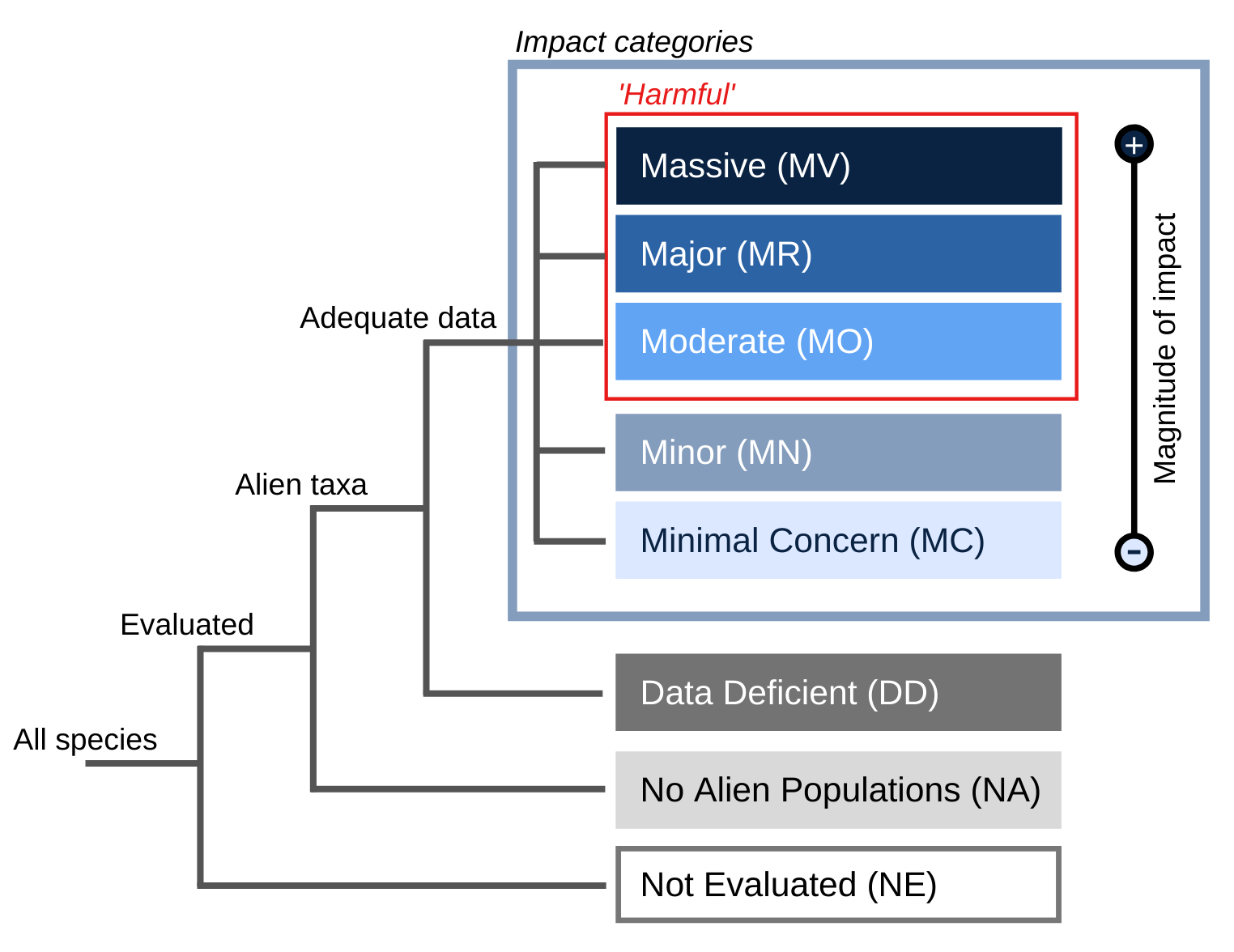
The House Finch is a host of avian malaria, which has also been detected in native bird species. Of the 2365 wild birds analyzed for blood parasites 7.8% were infected with Plasmodium (all of the native species were infected). The Apapane (Himatione sanguinea) population had the highest percentage of infected individuals. The House Finch population also had high percentages, although they were almost two-thirds lower than that of the Apapane. Malaria is currently one of the major factors affecting avian population patterns in the Hawaiian Islands has and has been one of many reasons for the decline of the native avifauna (van Ripper III et al. 1986).
Confidence rating
Low
Mechanism(s) of maximum impact
Transmission of diseases to native species
Countries of most severe impact
U.S.A.
Description of impacts
The house finch competes with and transmits the mycoplasmal conjunctivitis to native bird species in the U.S.A.. It is also a host of malaria in Hawaii, which caused the decline of the native avifauna.
Assessor
Tom Allmert; Thomas Evans
Contributors
Reviewers
Recommended citation
Tom Allmert, Thomas Evans (2026). Haemorhous mexicanus. IUCN Environmental Impact Classification for Alien Taxa (EICAT).